These three words get used interchangeably in emails and work orders, and the confusion costs money: a contractor quoted to "patch scaling" and a contractor quoted to "repair spalling" may be planning entirely different work. The words describe different geometries of damage, and geometry is a clue to the mechanism.
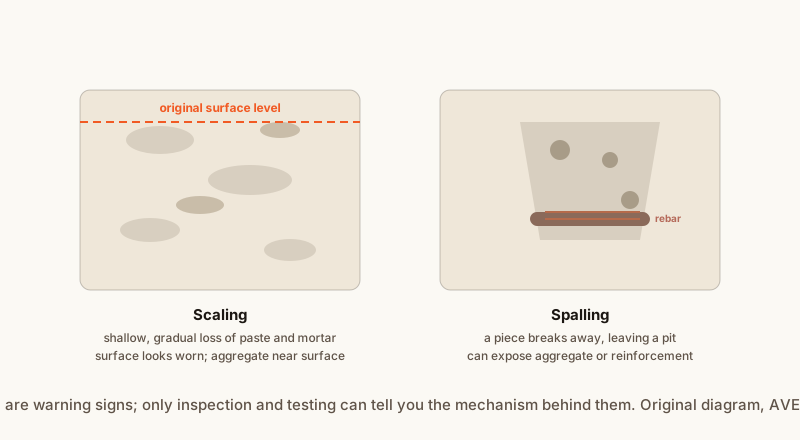
Scaling: shallow, progressive surface loss
Scaling is the gradual flaking away of the finished surface, usually paste and fine mortar first. It is typically widespread rather than localized, worst where water and deicing salt concentrate, and shallow: the affected depth is millimetres early on, deepening to exposed coarse aggregate in severe cases.
Scaling's classic cause is freeze-thaw cycling of a near-saturated surface in the presence of deicing chemicals, often compounded by weak surface paste from poor finishing or curing. It is measured and rated by methods such as ASTM C672 in laboratory contexts.
Scaling is a durability warning. It is rarely immediately structural, but it signals that the surface is losing the material that protects everything below, and that the same exposure is working on the whole element.
Spalling: a chunk breaks away
A spall is a localized loss of a piece of concrete, leaving a pit or void. Depths range from shallow to deep enough to expose reinforcement. Spalling is a symptom with several possible mechanisms:
- Reinforcement corrosion expanding behind the cover (the most consequential type; see rebar corrosion).
- Freeze-thaw pressure near the surface.
- Impact or mechanical damage.
- Pop-outs from unsound aggregate particles near the surface.
The geometry gives clues: corrosion spalls often align with bars or tie locations and show rust staining; impact spalls show fresh, unstained fracture faces; pop-outs are small and leave a shallow conical cavity with an aggregate fragment at its base.
Delamination: the invisible stage
Delamination is the separation of a surface layer from the substrate below, forming a planar void (usually along the top of reinforcement or along a weak paste layer) before any concrete has broken away. A delaminated area can look intact while being completely detached. Left alone, it becomes a spall, typically at the worst possible time.
Delamination is detected by sounding: a solid area rings, a delaminated area sounds hollow (chain dragging is the traditional method for slabs and decks). For a facilities manager, the useful mental model is that every delaminated area is a scheduled future spall; the schedule just has not run yet.
Why the distinction matters
- Response urgency differs. Scaling is usually a monitor-and-manage problem. Delamination is a find-it-and-plan problem. A spall exposing reinforcement is a prompt-repair problem, because the bar is losing section.
- Cost curves differ. Delamination repair before spalling is smaller and cheaper than after, because the concrete has not yet been lost.
- Diagnosis differs. A rust-stained spall suggests the corrosion pathway; a clean scaling field suggests freeze-thaw and salt; both can coexist on the same structure in different areas.
A caveat: visual observation is suggestive, not conclusive. Petrographic examination of a core can identify the actual mechanism (see our petrography article), and that evidence is worth having before large repair programs, not after.
What this means in Atlantic Canada
Winter salt exposure produces all three on the same assets. A garage deck might show scaling across the entrance lane, delamination over corroded bars mid-span, and pop-outs from aggregate scattered along a curb line. The inspection habit that catches all three early is the same: walk it every spring, photograph it, compare it to last year. Our spring checklist is built around exactly that.
Sounding: the 30-minute skill that finds delamination
Because delamination is invisible until it spalls, the detection method matters more for it than for the other two. Chain dragging (or hammer sounding on smaller areas) is the traditional technique, and it works because a delaminated layer does not transfer sound the way solid concrete does: solid areas ring, delaminated areas sound hollow or dull.
The technique is low-tech but real: it is the standard first survey on decks, slabs, and walls, and it is how maintenance crews on bridges and garages map areas before they fail. For an owner, the takeaway is that delamination is findable years before it becomes visible, which converts the worst repair timing into the best.
The mechanism checklist behind each appearance
When you encounter each defect, the useful follow-up questions:
Scaling: How long has the surface been in place? Is the affected area where salt and water concentrate? Is the paste soft or dusty between the scaled patches (which points at finishing and curing as contributors)? Does the same exposure area elsewhere show it too?
Spalling: Is there rust staining (corrosion is the likely driver)? Is the spall at a joint, corner, or tie location (cover details)? Was there an impact? Does the spall align with reinforcement below?
Delamination: Over what depth (paste layer or over reinforcement)? How extensive? Does it sit in an area with water history?
The answers sort the defects into mechanisms, and mechanisms into responses. A rust-stained spall over a corroded bar is a different project from a clean freeze-thaw scaling field, even when both appear on the same walk.
Why photographs alone are not diagnosis
A photograph shows geometry; mechanisms live inside the concrete. Two scaling fields can look identical in photos and differ completely under petrographic examination: one from freeze-thaw with a decent air void system, one from a weak over-finished surface with almost no air system. The responses differ, and the photographs cannot tell them apart. Where the stakes justify it (repair programs, disputes, premature failures), petrography on a core or two turns the visual impression into a defensible mechanism finding (our petrography article covers what the examination delivers).
For routine inspection purposes, the photographs' job is narrower: record location, type, and extent, and compare against last year. Diagnosis is a separate, deliberate step.
What this article does not tell you
It does not provide repair methods or a decision about any specific surface. Whether a given area of scaling or a specific spall indicates a mechanism needing engineering attention is a condition-assessment question.
Where to go next
Freeze-Thaw Damage in Atlantic Canada and What Road Salt Does to Concrete explain the leading causes, and Repair, Preserve or Replace? frames the response decision once the extent is known.