Product test evidence is only useful when the reader knows what was measured, on what, and against what. This article walks through the manufacturer-published laboratory evidence for PRO Tek Concrete, one method at a time, with the context and limits stated for each. The consistent frame: these results describe the tested specimens under the test conditions. AVENIQ distributes PRO Tek and does not perform independent testing; every report cited here was produced by the laboratories named and published by EverTek Canada.
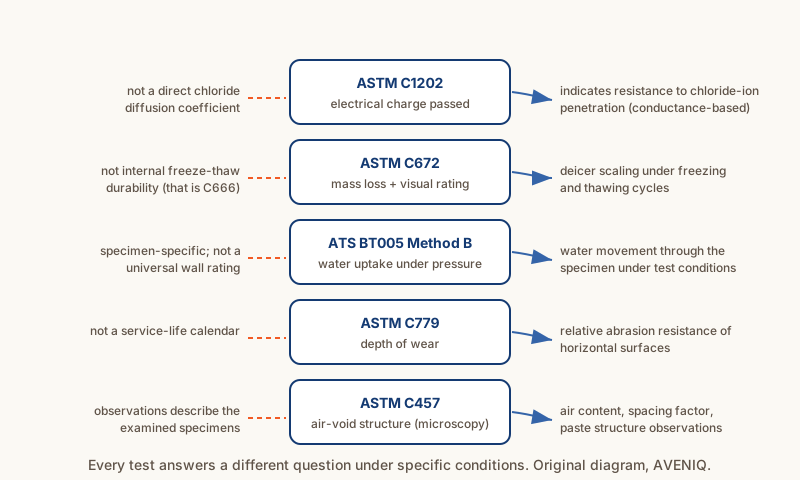
1. Deicer scaling: ASTM C672
What the method measures. Surface scaling resistance under freezing and thawing in the presence of a deicing chemical solution; results are cumulative mass loss and a visual rating from 0 (no scaling) to 5 (severe).
The report. Manufacturer-published report from CTLGroup (Skokie, Illinois) covering three treated and three untreated 12x12x3-inch slab specimens cycled 50 times with a calcium chloride solution.
Results. Untreated average cumulative mass loss at 50 cycles: 0.82 lb/ft2. Treated average: 0.05 lb/ft2. Visual ratings averaged 4.3 untreated versus 0.3 treated.
What it does not prove. It does not establish internal freeze-thaw durability (that is C666's question), does not predict field performance of any specific slab, and does not convert into a percentage of "extra life." The legitimate reading: in this specimen set under this method, treated specimens showed markedly less scaling than the untreated controls.
2. Water uptake: ATS BT005, Method B
What the method measures. Alberta Transportation standard BT005, Method B (penetration sealers), measures water uptake of sealed specimens under the method's pressure conditions.
The report. Brampton Materials Engineering (Mississauga, Ontario), reviewed by Haroon Raza, P.Eng., February 2025. Cores from a 50+ year old slab, part of a rehabilitation program in Hamilton, Ontario; 28-day sealer performance testing after shotblasting (sealer applied January 9, 2025; shotblast January 7).
Results. Untreated core: 529.5 g before immersion (SSD), 542.9 g after; mass increase 13.4 g. Treated core: 540.0 g before, 541.8 g after; increase 1.8 g.
What it does not prove. It does not establish that any other structure's walls or slabs will show the same reduction, nor performance against hydrostatic conditions beyond the method's pressure. The honest reading: in this paired comparison on this slab's cores, the treated specimen took up substantially less water under the test conditions.
3. Electrical indication: ASTM C1202
What the method measures. Total electrical charge passed through saturated specimens, categorized for chloride ion penetrability (High, Moderate, Low, Very Low, Negligible). It is conductance-based; it is not a direct chloride diffusion measurement (our C1202 explainer covers the nuance).
The report. Manufacturer-published report on two cores from a 50+ year old slab, tested May 15, 2025.
Results. Core-1A: 3,094 coulombs, corrected charge, Moderate category. Core-1B: 967 coulombs, Very Low category.
Reading it honestly. These are two results on two cores, without a stated untreated control pair in the published document we can verify. The two cores moved from the Moderate range into the Very Low range, which is the correct comparison to report. We do not state a percentage "chloride reduction," because that is not what the method measured, and we flag that a conductance-based result cannot be converted into a diffusion coefficient.
4. Abrasion: ASTM C779
What the method measures. Relative abrasion resistance of horizontal concrete surfaces; Procedure A (revolving discs) reports depth of wear over time.
The report. CTLGroup report on submitted specimens from the Rollins Garage project (Winter Park, Florida), received November 30, 2021, analyzed December 6-7, 2021, sample age specified at 2 years. The report notes that mixture proportions and cast date were not provided and that results specifically represent the submitted samples.
Results. 60-minute wear depth: 0.113 in untreated versus 0.050 in treated (native A method). Normalized: 0.096 versus 0.045 in.
What it does not prove. A wear-depth comparison is not a service-life calculation. ASTM's own framing of C779 as a relative method governs; the treated specimens showed materially lower wear under the method, on the submitted samples.
5. Petrographic package: ASTM C457 and penetration observations
What the method measures. ASTM C457 characterizes the hardened air void system (total air, void frequency, spacing factor, paste content); the petrographic examination (ASTM C856 framework) covers paste, aggregates, cracking, and reaction products, and in this package included depth of penetration observations.
The report. Manufacturer-published petrographic examination of cores from a 50+ year old slab, with hardened air-void analysis (modified point count, Procedure B) at two test horizons per core, conducted by Davroc (testing by Robert Ji per the summary table). Reported values include total air content, void frequency, paste content, chord length, specific surface, and spacing factor at each horizon.
Reading it honestly. The C457 data characterizes the air void systems of the examined cores at the examined horizons. Penetration-depth observations are petrographic observations of the examined specimens. C457 itself is an air-void standard, not a penetration test standard; where penetration observations are cited, they come from the petrographic work as a whole.
The pattern, stated plainly
Across all five areas, the published evidence is comparative and specimen-specific. That is normal and respectable laboratory evidence. What it supports: "in the referenced laboratory specimens, under the referenced methods, the treated concrete showed [measured difference]." What it does not support: universal performance claims, service-life extension numbers, superiority over named competitors, or suitability for any specific structure without assessment.
Two governance notes we hold ourselves to. First, where an EverTek summary document describes a test in terms that do not match the standard's actual scope (a known issue with at least one historical summary's C666 description), we rely on the standard's actual scope and omit the unverifiable claim. Second, manufacturer marketing phrases (permanent, blocks hydrostatic pressure, stops ASR) do not appear in our content as performance claims without test-specific support; where the TDS makes broad statements, we identify them as manufacturer statements.
Questions worth asking before specifying
- Can I see the current TDS and the original reports (not summaries) for the properties that matter to my project?
- What substrate, age, and condition do the results represent, and how does mine compare?
- What does the mock-up on my actual concrete show?
- Which claims apply to the method's specimens versus to my structure?
These questions are the point of the evidence discipline; a supplier confident in their documents will welcome them.
Where to verify everything
Every report cited above is published by EverTek Canada and linked from the PRO Tek product page. AVENIQ provides the current controlled TDS, SDS, and test reports on request. For the product overview, see What Is PRO Tek Concrete?, and for the honest fit assessment, Where PRO Tek May Fit, and Where It Does Not.