Nearly every concrete protection conversation eventually arrives at this fork: do we put a film on it, or put something into it? The two approaches are both legitimate and are chosen, in well-run projects, by matching mechanism to objective. Problems arise when one family is sold as if it were the other.
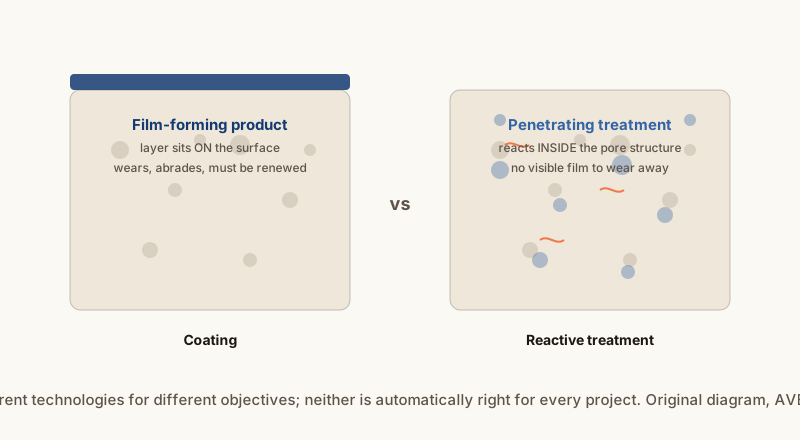
Film-forming products: protection as a layer
Film-formers (acrylics, epoxies, urethanes, polyaspartics) create a continuous membrane bonded to the surface. Protection lives in the film itself:
- Thickness is part of the protection; films are specified by mils of thickness.
- Appearance changes: gloss, colour, sheen. Decorative floors rely on this.
- Chemical resistance can be excellent (that is why epoxy is used in containment areas).
- The film is the wear surface: it abrades, chips, and peels, and renewal is a scheduled maintenance item.
- Moisture behaviour is a design question: films can trap vapour from below, which is why moisture testing precedes coating work on slabs-on-grade.
Films are the right answer for many objectives: chemical containment, decorative finish, wear resistance in a controlled facility, or a vapour-managing system specified by a designer.
Penetrating treatments: protection inside the matrix
Penetrating treatments are applied to the surface but are intended to travel into the pore structure and act there. The family includes several distinct chemistries:
- Silanes and siloxanes are hydrophobic: they repel liquid water while remaining vapour-permeable. Water beads, absorption drops.
- Silicate densifiers react with calcium hydroxide in the paste to form additional calcium silicate hydrate, hardening and densifying the surface zone. They are the workhorses of polished concrete floors.
- Modified reactive silicate treatments position themselves between densification and ingress reduction, reacting within the matrix and modifying pore structure rather than forming a film. EverTek's PRO Tek, distributed by AVENIQ, is described by its manufacturer as an alumina-modified reactive silicate of this type; its specific chemistry and evidence are covered in our evidence-led overview.
Because penetrating treatments leave no film, they change neither colour nor thickness, and there is nothing to peel. What they can do is also bounded by mechanism: they work only where they can reach and react, which makes substrate absorbency and surface preparation central.
The comparison that actually matters
Rather than "which is better," the honest comparison is a set of questions:
- What is the failure you are trying to prevent? Salt scaling of a sidewalk, chemical attack on a floor, water ingress through a wall, abrasion in a warehouse: each points toward different mechanisms.
- Does the surface need to change? If appearance (gloss, colour) matters, a film may be the answer. If appearance must not change, a penetrating treatment fits.
- Who maintains it? Films renew; penetrating treatments generally do not require film renewal but also do not create a replaceable wear layer.
- What comes next? Coating compatibility and vapour transmission both interact with what will be applied over the treatment later; the TDS and the coating manufacturer's requirements both apply.
Where claims discipline matters
This is the space where marketing pressure is strongest, and where the discipline of separating category research from product evidence matters most. Published literature on silicates or silanes in general describes what those chemistries can do under tested conditions; it does not by itself establish what any specific product does. Product-specific performance needs product-specific test evidence, which is the standard we apply in our PRO Tek test evidence article.
The preparation question, which decides almost everything
The two families make opposite demands of the substrate, and getting this wrong is the most common application failure:
- Films need a sound, prepared surface to bond to. Bond failure (peeling, blistering) is the film family's characteristic failure, and it is usually a preparation or moisture problem rather than a product problem.
- Penetrating treatments need an absorbent, film-free surface. The product must reach the paste. Any prior coating, curing compound, sealer, or contamination (oil, grease, silicone) blocks the pathway. The standard field check is the water absorbency test: dampen the surface; if it does not darken and absorb, a penetrating treatment cannot get in either.
This asymmetry explains why surface preparation is specified so differently for the two families, and why "prepare the substrate" is not boilerplate. For an existing slab with an unknown history, the absorbency check is the honest first step of any penetrating-treatment conversation.
What renewal looks like for each family
Maintenance profiles differ fundamentally:
- Films are sacrificial systems in the wear sense: they scratch, abrade, and lose gloss, and renewal (recoat or strip-and-recoat) is a scheduled cost. Their advantage is that renewal restores full performance and the film is inspectable.
- Penetrating treatments have no film to inspect or renew, which lowers maintenance overhead but also means there is no visual indicator of remaining protection. Where penetrating treatments claim long-term effect, that claim rests on the chemistry persisting in the matrix (and on product-specific evidence), not on something you can see.
For an owner planning lifecycle costs, the comparison is between a scheduled, visible renewal cost (films) and an intermittent, less visible re-application question (penetrating). Both are legitimate; the honest comparison depends on the product's actual documented longevity, not on category assumptions in either direction.
Specification literacy: what the documents call each family
A note for anyone reading specifications: the families appear under different vocabulary depending on the document's vintage and the writer's discipline.
- Coatings appear with dry film thickness (DFT) requirements, adhesion testing references, and sometimes vapour permeance requirements.
- Penetrating treatments appear with absorbency requirements, application rates by substrate, and sometimes penetration depth verification (commonly via petrographic examination of cores).
- Densifiers appear in polished-concrete and industrial floor specifications, usually with hardness or abrasion references.
When a spec and a product do not speak the same vocabulary, that is the moment to stop and reconcile (the TDS article covers the document mechanics). Forcing a product into a category it does not occupy is how specification disputes start.
What this article does not tell you
It does not rank products or recommend one for a project. Specifying is an engineering decision, and the right answer depends on the substrate, exposure, and project requirements.
Where to go next
Concrete Densifier vs Sealer: What Is the Difference? drills into the terminology, Where PRO Tek May Fit, and Where It Does Not applies the framework to one specific product honestly, and How to Read a Concrete Product Technical Data Sheet equips you for the documents themselves.