Concrete protection conversations often blur two completely different situations: a slab that has not been poured yet, and a wall that has been standing for thirty years. The durability questions overlap, but the tools, the timing, and the economics are different enough that they are better treated as separate conversations.
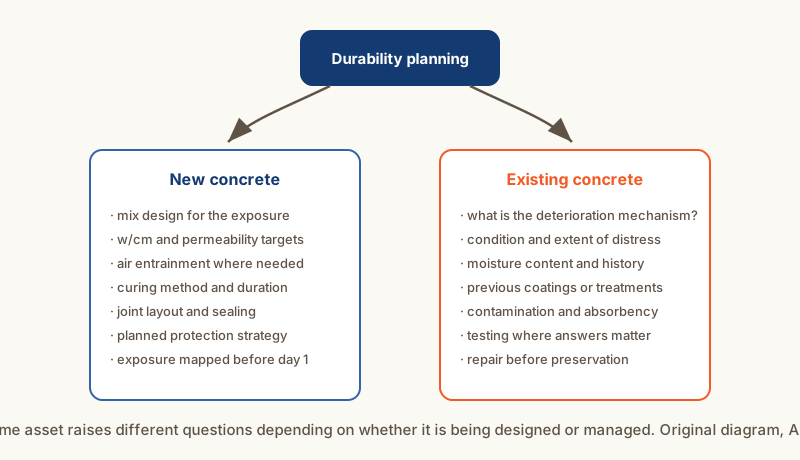
New concrete: durability is designed, not added
For a new structure, durability decisions are made in the specification and executed in the first days:
- Mix design for the exposure. Water-cementitious ratio, air entrainment, cementitious materials, and permeability targets matched to the exposure the element will actually face (why exposure matters).
- Cover and reinforcement appropriate to the chloride and carbonation risk.
- Curing, executed properly, which sets the surface zone quality that everything else builds on (why curing matters).
- Joints located and sealed so movement and water have controlled paths.
- Drainage and geometry so water leaves the surfaces quickly.
Protection at this stage is mostly about not compromising these basics, and about any treatment the specification calls for at the right window (some penetrating treatments are designed to be applied to green concrete within the curing period; the TDS defines that window for the specific product).
The economics of new construction favour this ordering heavily: durability designed in costs little, and the same outcomes attempted later as repairs cost orders of magnitude more.
Existing concrete: durability is assessed, not assumed
For an existing structure, the conversation starts with condition, because the unknowns dominate:
- What mechanism, if any, is active? Scaling, corrosion, ASR, carbonation, chemical attack. Diagnosis can be visual, sounding-based, or laboratory-based (petrography, chloride profiles) depending on the stakes.
- What is the moisture and exposure history? Saturation drives most mechanisms; the areas that stayed wet are the areas to examine first.
- What has been applied before? Previous coatings, sealers, curing compounds, and repairs all affect what can reach the substrate now. A penetrating treatment applied over an invisible old film does nothing; surface preparation is where that conversation starts.
- Is the concrete still sound? This is the boundary between repair and preserve (the decision framework).
The practical order for existing assets: diagnose, repair what needs repair, then consider preservation of the sound remainder. Applying a preservation product over active distress treats the symptom and hides the problem.
Why the same product means different things in each conversation
A penetrating treatment illustrates the split. On new concrete, the question is the specification window and whether the treatment's role fits the project's curing approach (the TDS defines both). On existing concrete, the first questions are absorbency, contamination, and whether any repair comes first; the treatment's role is evaluated against the diagnosed mechanism, not applied as a default.
Neither conversation is more legitimate than the other, but their failure modes are different: on new concrete, the risk is undermining curing or specification compliance; on existing concrete, the risk is treating a symptom the product cannot reach.
What this means for owners planning projects
- For new work: durability belongs in the specification, and the inspection of finishing and curing is where it is protected.
- For existing assets: assessment first, category decision second, product conversation last.
- For both: the vendor who asks about your substrate and exposure before quoting is demonstrating the discipline that predicts a good outcome.
The handover moment: where the conversations meet
There is one day in every asset's life when the new-concrete conversation ends and the existing-concrete conversation begins: handover. Two practical habits at that boundary pay for themselves for decades:
- Document the as-built condition. Photograph the surfaces, record what treatments were applied and when, and file the mix and test records. Every later assessment starts from this file (the asset management article builds on it).
- Start the annual inspection cycle immediately. The first spring walk establishes the baseline that every later comparison uses (the inspection checklist).
Assets that enter service with a baseline record and an inspection habit are managed assets; the same structures without them are, within a few years, just concrete with complaints.
The transition cases that catch owners
A few situations sit deliberately at the boundary, and knowing them prevents mistakes:
- Concrete a few years old, distressing early. It is "existing" for conversation purposes, and the first question is mechanism: is this a materials or workmanship issue (dusting, early scaling), an exposure issue, or something moving? Premature distress is a diagnosis question, not a product question.
- New concrete placed next to old. Repair and replacement work that ties into existing structures inherits the existing structure's questions: moisture, chlorides, movement. The specification for the new pour should address the junction explicitly.
- Existing concrete being enlarged or reused. Condition assessment of the old portion is part of the design of the new work; the old slab is now substrate, with all the existing-concrete questions that implies.
- "Protection" proposed as a fix for distress. The clearest marker of the two conversations being blurred: a preservation product being sold as the answer to active deterioration. The repair-or-preserve decision framework exists to catch exactly this.
What this article does not tell you
It does not specify mixes, treatments, or procedures for any project. It organizes the two conversations so their questions get asked in the right order.
Where to go next
The First 24 Hours of Concrete and Why Curing Matters cover the new-concrete window, Repair, Preserve or Replace? covers the existing-asset decision, and Where PRO Tek May Fit, and Where It Does Not applies both conversations to one product.