When someone first learns that hardened concrete is full of connected pores, the usual reaction is disbelief. Concrete can be dense, strong, and load-bearing while also being a porous material that water can move through. Both things are true, and the second one quietly drives most of what eventually goes wrong with concrete structures.
Why concrete has pores in the first place
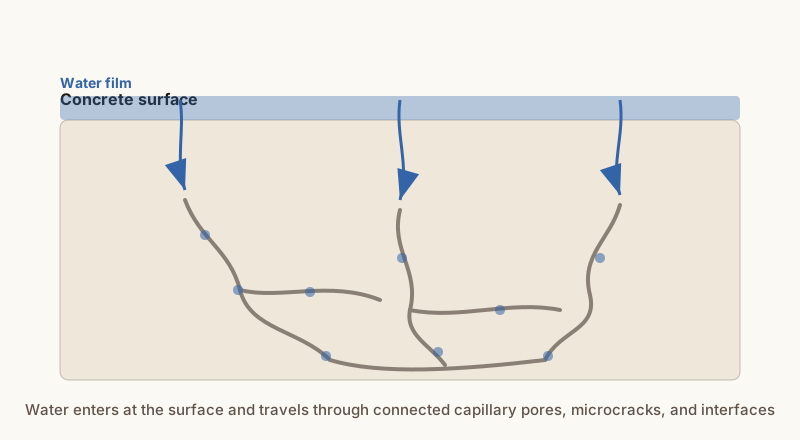
Cement hydration produces calcium silicate hydrate (C-S-H), the primary binder of hardened paste. C-S-H itself contains gel-scale pores, and the paste always retains a network of larger capillary pores left over from the original mix water. Beyond the paste, there are interfaces around aggregates, entrained and entrapped air, and, in real structures, microcracks and joints.
The important question for durability is not whether pores exist (they always do) but how connected they are. A low water-cementitious mix that hydrates well leaves fewer connected capillary pathways. A wet, poorly cured paste leaves many more. Transport follows connectivity.
The ways water moves
Water does not have a single mode of transport through concrete. Several mechanisms run in parallel, and which dominates depends on the exposure:
Capillary suction. Small pores pull water inward the way a paper towel pulls up spilled coffee. This does not require pressure; surface tension does the work. Capillary suction explains why concrete in contact with damp ground or ponded water takes up water even without any hydrostatic head.
Permeability. When water is pushed through by pressure, the relevant property is permeability. Lower permeability slows pressure-driven flow. This matters below grade and in any structure holding back water.
Vapour diffusion. Water vapour migrates through the paste from high to low vapour pressure, even where liquid water cannot. This drives moisture movement through walls and slabs on grade.
Absorption and wetting-drying cycles. Concrete alternately takes up water when wetted and releases it when dry. Repeated cycles move dissolved salts inward and can concentrate them near the surface, which is one reason splash and tidal zones are so aggressive.
Cracks and joints. Everything above describes transport through sound paste. A crack of a fraction of a millimetre can admit water at rates the surrounding paste would not allow in years. Cracks and joints are shortcuts, and they are where most leakage complaints start.
Moisture gradients: why dry-looking is not dry
Concrete does not dry uniformly. The surface equilibrates with the air first; the interior follows, sometimes months or years later in thick elements. A slab can feel dry to the touch and read low on a surface moisture check while its interior remains saturated, especially after a winter of salt exposure.
This matters for several practical reasons:
- Coatings applied over still-wet concrete can fail by vapour pressure from below.
- Freeze-thaw damage is governed by how saturated the concrete gets, not how damp it looks on a given day.
- Chloride testing that only samples a dry surface can understate the total chloride inventory in the slab.
Saturation is the switch for other mechanisms
Water transport matters both for what it carries (chlorides, sulfates, carbon dioxide dissolved as carbonic acid) and for what it enables:
- Saturated concrete cannot dry out before a freeze, so freeze-thaw cycles act on a full pore system.
- Corrosion of reinforcement requires moisture to function electrochemically.
- Alkali-silica reaction needs moisture to expand.
This is why drainage, joint sealing, and surface condition often matter as much as the concrete itself. A structure whose surfaces shed water quickly ages differently from one where water sits for days.
What this means in Atlantic Canada
Atlantic Canada combines high annual precipitation, a long freeze-thaw season, and heavy deicing salt use. The practical consequences:
- Horizontal surfaces that pond are the highest-risk surfaces on most sites.
- Snow stored against concrete walls melts into a saline soak that capillary suction happily pulls in.
- Structures near the coast get the marine version of the same problem, with spray and fog delivering chlorides even without road salt.
The field checks that read moisture condition
For owners who want a practical grip on moisture without a lab, the field-accessible indicators:
- The absorbency check. Dampen a small area: a surface that darkens and absorbs is open to water (and to any penetrating chemistry); a surface that stays wet-on-top has a film or dense finish that blocks absorption (why this matters for treatments).
- Ponding mapping. After rain, photograph every area that stays wet more than a day. These are the saturation engines of the site.
- Efflorescence and staining patterns. White mineral deposits and dark damp lines trace the water paths through and across elements.
- Moisture measurement where decisions require numbers (slab moisture testing before coatings is a standard example).
None of these replaces laboratory measurement where decisions are critical; all of them turn "is water moving here?" from a guess into an observation.
The drying myth worth retiring
"Concrete cures for 28 days and then it's done" misdescribes both curing and drying. Hydration can continue for years where moisture and conditions permit (the mechanism behind internal curing research), and thick elements can take far longer than anyone expects to reach moisture equilibrium with their environment. Two practical consequences:
- A new slab is not "dry" on any schedule you can assume; moisture-related coating failures on young slabs are the textbook example.
- An old structure's interior can still be wet while its surfaces seem dry, which matters for any treatment or coating decision on existing concrete.
Both consequences push the same direction: moisture is measured, not assumed, whenever the decision matters.
What this article does not tell you
It does not quantify how much water any specific structure absorbs, and it does not imply all porosity is bad; entrained air is deliberately added and beneficial. Whether a given concrete's transport properties are acceptable depends on its exposure, which is an engineering assessment.
Where to go next
The follow-on article Porosity, Permeability, Absorption and Sorptivity Are Not the Same Thing untangles the vocabulary, and Why Concrete Deteriorates places water transport in the bigger picture. For the consequences of saturation, start with Freeze-Thaw Damage in Atlantic Canada. You can also watch our recorded durability webinars on the events page.