The most expensive mistake in concrete asset management is not choosing the wrong product. It is choosing the wrong category of intervention: preserving concrete that needed repair, repairing concrete that needed replacement, or replacing concrete that only needed its drainage fixed. This article gives owners a framework for keeping the categories straight.
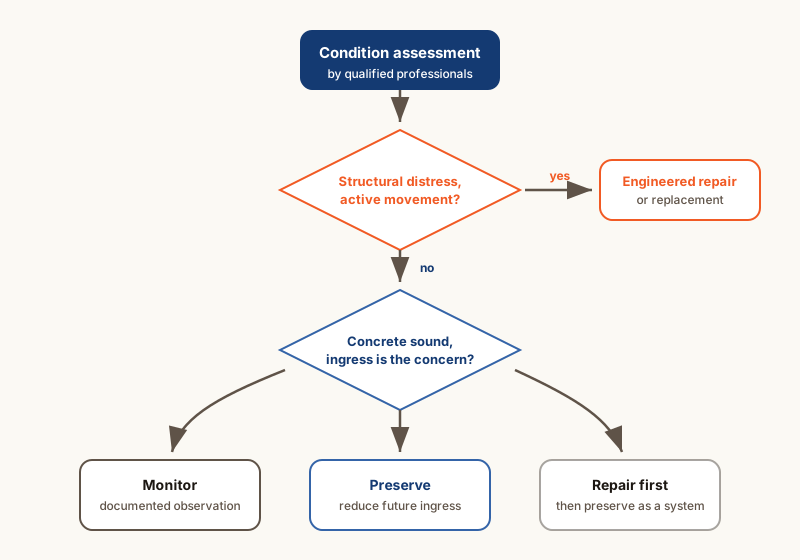
Question one: is it structural?
Before any other analysis, answer whether the element is structurally sound. Signs that call for engineering assessment before any other work:
- Exposed reinforcement with significant section loss.
- Active movement: growing cracks with offset, closing joints, settlement.
- Delamination over a large area, suggesting the section is no longer acting compositely.
- Any distress in a load-bearing element whose capacity is in question.
If the answer is yes, this is an engineering project. Preservation products and surface repairs do not enter the conversation until the structural question is resolved. This ordering is not bureaucratic caution; it is how the repair industry's own standards (ACI 562, ICRI guidance) frame the sequence.
Question two: what is the mechanism?
If the element is structurally sound, the next question is which deterioration mechanism is working, because the response differs by mechanism (our deterioration overview maps them):
- Surface scaling from freeze-thaw and salt points to saturation management and, where appropriate, surface protection.
- Corrosion points to the ion supply: chlorides or carbonation, and the moisture that drives them (chloride ingress, carbonation).
- Leakage through joints points to joint systems, not to the concrete.
- Abrasion and dusting point to surface paste quality.
Question three: which category of intervention?
Monitor. For stable or cosmetic conditions: document, compare annually, intervene if trend changes. The cheapest category and the right one most of the time.
Preserve. For sound concrete in a harsh exposure: reduce the rate of deterioration before damage occurs. The menu includes drainage and joint work (usually first), ingress-reducing treatments where the evidence supports them, and moisture management. Preservation is only economical on sound concrete, and that is its whole value: extending the life of what is still good.
Repair. For existing damage: spalls, delaminations, joint failure, corroded bar. Repair is mechanism-specific: patching a corrosion spall without addressing chloride or moisture conditions produces a repair that fails on schedule. Repair can and should be combined with preservation of the surrounding sound concrete, which is why "repair" and "preserve" often appear in the same project.
Replace. When the asset's condition, remaining service, or economics say so. Indicators include repair costs approaching replacement cost, extensive section loss, and distress patterns indicating the element is beyond local repair. Choosing replacement deliberately is a success of the management framework, not a failure.
What preservation is not
The boundary that saves the most money:
- Preservation is not structural restoration. No ingress-reducing treatment restores load capacity, replaces corroded steel, or corrects settlement.
- Preservation is not repair. A sound-but-exposed surface is preservation territory; a spalled, delaminated, or corroding area is repair territory first.
- Preservation is not a substitute for drainage. If water management is the root cause, fix the water.
Stating these plainly is a credibility test for any supplier; a supplier who tells you where their product does not fit is the one worth having back (our PRO Tek fit article applies this test to one product explicitly).
The sequence that works
For any significant asset:
- Structural assessment where stakes justify it.
- Mechanism diagnosis (visual, sounding, and where needed, petrography and chloride testing).
- Category decision: monitor, preserve, repair, or replace.
- If repair: fix the damage, then consider preserving the repaired system and the sound remainder.
- Document what was done, and re-inspect on the annual cycle.
The economics in one example
Consider a 30-year-old parking deck with entrance-lane scaling, several rust-stained areas, and no testing on file. Three responses, three outcomes:
- Patch the stained areas only. Cheapest this year. But if chlorides have reached the steel more broadly (unknown, because untested), the patches sit over continuing corrosion, and the deck reappears on the work order in a few years. The spending repeats.
- Test first, then act. The survey finds the delaminated areas and the chloride profile distinguishes "arriving" from "arrived." The repair scope is targeted (not blanket), drainage and joints are fixed, and protection of sound areas is evaluated on evidence. Costs more up front, buys a decade-scale strategy.
- Replace prematurely. Without diagnosis, an owner can be talked into replacement on structures where 80% of the concrete is sound; the records are what prevent that conversation from being settled by whoever speaks most confidently.
The example generalizes: the testing and diagnosis steps are what keep each category decision honest. The framework without the evidence is just three ways to guess.
Repair specification basics every owner should check
When a repair project is being specified, the fields that determine whether it addresses the mechanism:
- Mechanism named in the spec. "Patch deteriorated concrete" is not a mechanism-based scope; "remove delaminated cover over corroded top mat, clean and reinstate cover, address chloride exposure" is.
- Surface preparation depth, stated (sound concrete, not just removal of loose material).
- Bond and compatibility requirements, including moisture conditions and any treatment or coating interfaces (pull-off testing exists for project-critical adhesion questions).
- Post-repair protection, decided as part of the same project, not deferred to a future complaint.
- Inspection of the repair after completion and at the following annual cycle.
A repair spec that lacks these fields invites the patch-and-return cycle. Owners who read repair scopes against this list before awarding catch most of the failure modes at the quotation stage.
What this article does not tell you
It does not prescribe solutions for any asset, and it does not rank products. Both of those require condition assessment and engineering judgment on the specific structure.
Where to go next
Concrete Asset Management for Municipalities puts this framework in a portfolio context, Scaling, Spalling and Delamination covers the symptoms that trigger the decision, and Where PRO Tek May Fit, and Where It Does Not shows the preservation category examined honestly for one product.