A warehouse floor's most common enemy is not water or salt; it is the daily grinding of traffic. Abrasion determines how a floor ages in the places people and machines actually operate, and it is the property most directly tied to the quality of the concrete's surface zone.
What abrasion actually is
Abrasion is progressive wear of the surface under rolling, sliding, and impact traffic: forklift tyres, steel-wheeled lifts, pallet dragging, foot traffic on gritty surfaces. The mechanism is mechanical removal of paste and fine mortar from the top zone. Everything that weakens the surface paste (high w/cm, water added on site, over-finishing with trapped bleed water, poor curing) lowers abrasion resistance; everything that densifies the paste raises it.
Dusting: abrasion's quiet sibling
Dusting is the appearance of a loose, powdery film on a slab surface, rub-off under foot or pallet traffic. It signals weak paste at the surface, typically from finishing or curing problems rather than from traffic itself. Dusting and abrasion are related (both are surface-paste quality problems) but not identical: a slab can dust badly with modest traffic, and a well-made surface can abrade for years without dusting.
Densification is the standard answer to dusting-prone surfaces: silicate treatments react with the paste and harden the surface zone, which is why the polished-concrete industry is built on them (see densifier vs sealer).
How abrasion is measured: ASTM C779
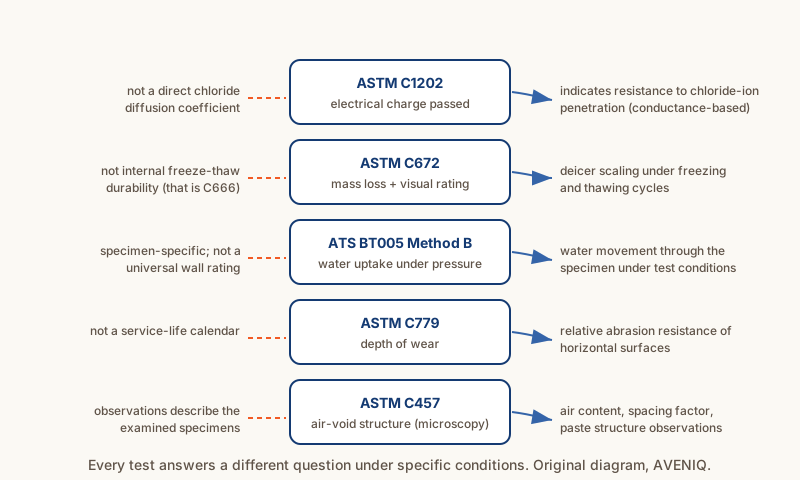
ASTM C779 covers several procedures for measuring relative abrasion resistance of horizontal concrete surfaces; the most cited is Procedure A (revolving steel discs). The machine grinds a slab specimen for a defined time, and the result is the depth of wear, in inches or millimetres, at intervals (15, 30, 45, 60 minutes).
ASTM is explicit that the method provides a relative comparison. A treated specimen showing a lower wear depth than its untreated control has demonstrated better abrasion resistance under that method, on those specimens. Converting that into "years of floor life" requires a correlation between wear depth and service life that the standard does not provide and that generally does not exist.
Reading an abrasion result honestly
For any abrasion comparison, the same fields matter as in any test:
- The specimens (what concrete, what age, what condition).
- The procedure (A, B, or C of C779) and duration.
- The control and the treated result, in the same units.
- Whether the report itself notes that results represent the submitted samples.
For example, in a published third-party abrasion report on one product (PRO Tek Concrete, tested by CTLGroup on submitted specimens from a garage project), the 60-minute wear depth was 0.113 inches for the untreated specimen versus 0.050 inches for the treated specimen. That is a legitimate comparative result for those specimens; it is not a universal promise for every floor, and our PRO Tek evidence article presents it in exactly that frame.
What owners can influence
- New construction: specify abrasion-relevant finishing and curing practices, and verify them. The surface zone is built in the first days (why curing matters).
- Existing slabs: identify the mechanism of wear or dusting before treating. Dusting from weak paste responds to densification; wear from traffic on a sound slab may be a maintenance or overlay decision; a dusty, soft surface may need mechanical removal and re-treatment.
- Match the expectation to the exposure: a distribution centre's main aisle and a mechanical room floor are different abrasion worlds.
How facilities actually manage abrasion
Abrasion management in a working facility is mostly operational, and the levers are unglamorous but effective:
- Housekeeping. Grit on a floor turns sliding and rolling loads into grinding laps. Clean floors wear slower; this is the cheapest abrasion program there is.
- Wheel maintenance. Worn or flat-spotted forklift wheels concentrate loads and scrub harder. Fleet maintenance is floor maintenance.
- Traffic routing. Where turning and acceleration happen, wear concentrates; moving turning points or protecting known hot spots extends floor life measurably.
- Joint protection. Joint arrises take the worst impact; protected or well-maintained joints stop small problems from becoming floor-wide complaints.
When abrasion indicates a deeper problem
Sometimes "the floor is wearing out" is really a symptom of something else:
- Dusting that appeared early in the slab's life points to surface paste quality (finishing, curing, water addition), not traffic. The fix addresses the paste, not the operations.
- Wear localized at joints points to joint maintenance, not surface treatment.
- Rapid wear concentrated in new areas can indicate a change in operations (new equipment, heavier loads, changed routes) or a surface that has finally reached the end of its paste.
- Wear with moisture signs (dark patches, blistering coatings) redirects the investigation below the surface.
This is the diagnosis-before-treatment rule from our floor article applied to the wear question specifically.
What a mock-up tells you that a report cannot
For treatment decisions on existing floors, the mock-up answers the questions the lab report cannot:
- Does this slab actually absorb (the substrate question the lab specimen answers by assumption)?
- What does consumption look like on the actual surface (coverage varies with porosity)?
- Does the appearance change in ways operations will accept?
- Does the treated patch survive a week of actual traffic before you commit the floor?
Suppliers confident in their evidence will propose the mock-up themselves. A vendor who resists the mock-up on an existing slab is telling you something about how their claims were generated.
What this article does not tell you
It does not set acceptance values for any facility, and it does not evaluate any specific product beyond citing one example test in its proper context. Floor specification is an engineering and operations decision.
Where to go next
Industrial Concrete Floors: Water, Abrasion and Chemical Exposure applies these ideas to facility management, Concrete Densifier vs Sealer covers the treatment families, and How to Read a Concrete Product Technical Data Sheet covers the documents where abrasion claims live.